Dancer. Choreographer. Anti-Racist.
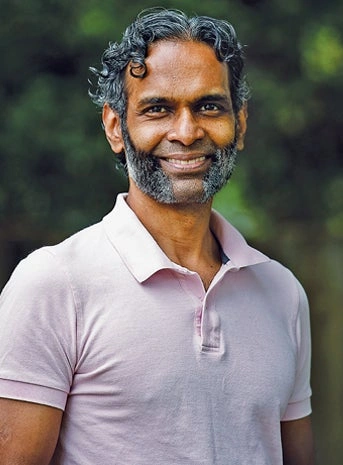
Daniel Phoenix Singh is a choreographer and cultural leader whose work bridges performance, community, and systems change. Across dance, higher education, arts policy, and public leadership, his practice brings together rigorous movement inquiry, cultural knowledge, and a sustained commitment to anti-racism and collective transformation.
Dance as Connection and World Building
For me, dance at its essence is about connecting person to person, whether on stage or as a participating audience member. It is one of the last art forms that still insists on live participation and has so far escaped being compressed into the computer or phone screen—though dance for camera is a burgeoning threat. In my choreography, I strive to offer artists and communities the unique opportunity to experience dance as a tool for linking the arts, cultures, and social causes. Dance allows me to exist in harmony as a South Asian, a gay man, an immigrant, an anti-racist, and a person of color, all while navigating multiple relationships with my home country. Dance is the one place where I am not relegated to check boxes, but where I can bring together all aspects of my cultural and social heritage as a cohesive whole. As such, I am choreographing new identities that provide a face and a voice for new realities—world building through dance.
I strive to build connections through my dance making and value its power to bring people together; this process is deeply rooted in anti-racist/anti-oppression frameworks. I am particularly interested in using creativity as a starting point for world building and then finding ways to make these imaginary worlds a reality. Creativity is a form of resistance and requires resistance, whereas resistance does not necessarily involve creativity and often fails to move beyond the oppressor’s parameters. Creativity, as opposed to resistance, is important for me because resistance already locks us into the rules and frameworks of the oppressor or ruling class.
Like my identity, the movement I create is hybrid: it borrows from both Indian traditional dance and modern dance; layers on collages of text and images; sources narratives from communities I work with; and weaves together a tapestry for participating audiences. My hope is that by providing multiple entry points, artists and communities find their path into complex topics in ways that are accessible. In many spaces, artists are told to leave emotions outside and just present the facts. We are often coached to present the work “neutrally” so the audience can feel what they feel without our emotions tinting their feelings. I open up pathways for dancers and community members to be both a feeling mind and a thinking body, allowing them to finally bring their emotions into their thinking.
Tools, Frameworks, and Action
I realize that the tools and training I have inherited are broken—marred by appropriation, casteism, patriarchy, and other overlapping tensions. Even the language with which I primarily engage is a colonizer’s language. I try to counter this hegemony by teaching my six-year-old twins Tamizh, my mother tongue, letting them be feeling elementary schoolers instead of becoming numb drones.
In my dance making, I use an anti-racist framework to address equity and counter white supremacy or ruling class oppression. For me, anti-oppression and anti-racism dance making involves eight core actions—applied in myself as the choreographer, with my collaborators, and with the participating audience:
- Grounding in self and starting at the root;
- Exploring all possibilities in the creativity to resistance spectrum;
- Reframing the issues at stake;
- Redistributing stolen resources, including restitution for ongoing harm;
- Democratizing resources, power, and the economy;
- Operationalizing experiments in anti-racism (in ripples from internal to external);
- Mobilizing and building support for the work;
- Building solidarity across movements; and
- Leading adaptively and sustaining parallel systems for change.
Approaching my dance making from an anti-oppression lens helps me take my inherited casteist, colonial, and imperial education and dance training—using these appropriated, broken, oppressor’s tools and the colonizer’s language—to find room for creativity and world building toward what our lives could be: on stages, in dance studios, and in communities.